Last summer, I traveled to Nairobi, Kenya to intern at the Life & Peace Institute (LPI) as the organization’s Global Policy Intern. LPI is an international non-governmental organization (INGO) that supports and promotes bottom-up nonviolent approaches to conflict transformation and positive social change. I was connected to the organization through the Applied Peacebuilding and Conflict Resolution: Fieldwork Competencies course at Columbia’s School of International and Public Affairs, which helped me understand the different frameworks, values, strategies, and skills essential to building peace. Thanks to the gracious support from the Center for African Education’s Travel Grant and the Carmela and Marie F. Volpe Fellowship, I had the opportunity to work and travel alongside my colleagues to meet with partners and donors alike, gaining a deep understanding of the organization’s work and contributing to learning and reporting processes.
As an Institute, LPI implements programming through and in partnership with local civil society organization (CSO) partners across the Horn of Africa. The Global Policy Unit (GPU) specifically focuses on bridging research, policy, and practice by developing, piloting, and learning how to advance more inclusive and meaningful policy engagement models. The GPU’s work spans across all of LPI’s programming, so I had the chance to collaborate with colleagues in regional as well as community-specific programs. My primary role entailed working directly on two small grant processes: the Transitional Justice & Reconciliation (TJ&R) small grant initiative and the Cross-Border Cooperation (CBC) small grant initiative. Since these grants were at different stages of the implementation process – one was just starting while the other was just ending – I got to be involved in the entire lifespan of the small grant process.
As a follow-up to a training that LPI held in 2022-2023 on the African Union’s Transitional Justice Policy, in early 2024, the organization put out a call for applications and selected four CSOs working across the Horn to support them in designing and implementing interventions that advance transitional justice and reconciliation in their communities. Given that the TJ&R grant was only in the launch stage when I arrived, I helped the team prepare for the small grant pre-implementation workshop in Nairobi and developed and disseminated a baseline survey during the workshop itself. Throughout the weeklong event, I also led a World Café discussion with representatives from the four implementing CSOs, taking note of the ways in which LPI could best support them in the small grant implementation process and beyond.
The CBC small grant provided funding to a group of 19 CSOs (including women-led and youth-led organizations) working in five clusters across the Karamoja region, covering northeast Kenya, northwest Uganda, southeast South Sudan, and southwest Ethiopia. These CSOs identified and addressed recurring conflicts (and their root causes), established local peace initiatives and platforms, and supported existing ones through trainings and equipment provision. By the start of my internship, the CBC small grant was in its final stages, so I assisted in the closing phase of the grant. As part of my role, I traveled to Kisumu, a Kenyan city off Lake Victoria (bordering Uganda and Tanzania), to assist in the coordination of the post-implementation lessons learned workshop. For this workshop, I created and sent out an endline survey to gauge participants’ learnings from the small grant process and facilitated a World Café discussion on the challenges and opportunities for consortium-based funding models in the borderland context.
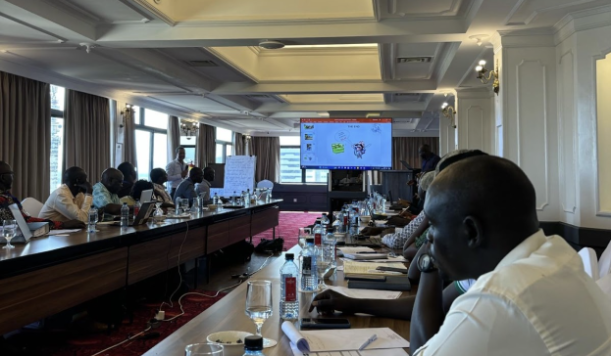
About this photo. CBC lessons learned workshop participants listening in to a finance presentation
Through these experiences, I had the privilege of speaking and connecting with local leaders working tirelessly to resolve deep-rooted conflicts and build peace in their communities. Having a dialogue about the kind of support that would be most impactful to CSOs – instead of assuming and prescribing solutions – showed me just how an organization can not only talk the talk (on localization and collaborative learning) but also walk the walk.
On a project level, I contributed to a few ongoing projects related to donor coordination and the roles of the United Nations (UN) and civil society in peace and security efforts. For example, the GPU partnered with the Dag Hammarskjöld Foundation (DHF) and the Global Partnership for the Prevention of Armed Conflict (GPPAC) to conduct research on donor coordination and resourcing of local peace actors. As part of this project, I met with six representatives from donor agencies working in East Africa to learn about how they coordinate with other donors on peacebuilding programming and how they could invite local peace actors to participate in these spaces. Following the interviews, I synthesized these reflections to incorporate them into a joint report with findings from DHF’s and GPPAC’s research in the Middle East and North Africa region as well as Latin America and the Caribbean.
Additionally, one of the highlights of my time in Kenya was when I visited the UN Headquarters in Nairobi, where I participated in an interview of UN Resident Coordinator in Kenya, Dr. Stephen Jackson, alongside my supervisor Lesley Connolly and colleague Eden Matiyas. The interview, published in the September 2024 edition of LPI’s Horn of Africa Bulletin (HAB), featured key takeaways from our conversation with Dr. Jackson, including his perspective on Kenya’s commitment to multilateralism and the future of sustainable financing for peacebuilding and development in the Kenyan context.
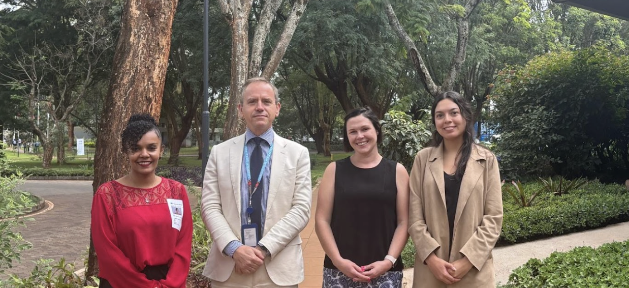
About this photo. Interview with Dr. Stephen Jackson, UN Resident Coordinator in Kenya, with my supervisor Lesley Connolly and colleague Eden Matiyas
Speaking with donors and high-level officials reminded me of the importance of locally-led development and purposeful inclusion of local actors in coordination spaces, not only on paper but also in practice. There is much work left to be done in this domain, but flexible and trust-based funding to local CSOs doing the work is an important first step.
Beyond contributing to logistics and report writing, one of the most enriching aspects of my internship were the opportunities I had to take part in internal and external convenings and the conversations that came about in these spaces. In my first few weeks, I assisted with the organization’s June 2024 HAB Forum, an event to showcase policy-relevant insights on local and national transitional justice and reconciliation processes in Kenya, Ethiopia, and Somalia. I was also encouraged to attend events put on by partner organizations, like an event on the crisis in Sudan at the Rift Valley Institute, for instance. Outside of Nairobi, I attended the Horn of Africa Regional Program’s (HARP) reflection session in Diani, and I also visited the LPI office in Addis Ababa to learn more about the work of my colleagues working in the Ethiopian context. Along the way, my colleagues took me under their wing, teaching me words and phrases in Kiswahili and Amharic, and sharing stories of their lives and families with me, as I did of mine. We bonded over our favorite European soccer teams and players, reggaeton and Afrobeats artists, and cracked jokes about internet memes, fostering a true sense of camaraderie and community.
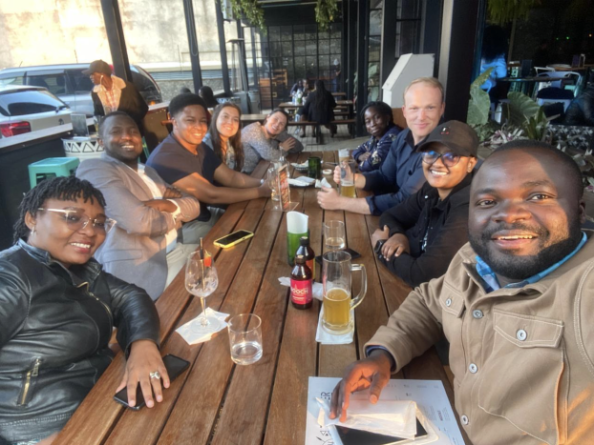
About this photo. LPI team photo at the goodbye celebration that the team hosted for my colleague Aaron Stanley and myself
Reflecting on my summer in Kenya, I gathered invaluable lessons on cross-cultural communication, relationship-building, and finding hope in the face of hardship. I learned what it means to meaningfully engage with others and approach complex challenges with empathy, resilience, and a belief in the transformative power of grassroots action. Now more than ever, I’m determined to pursue a career at the intersection of peacebuilding, education, and locally-led development, and I hope to build on my learnings from this experience upon graduation.