Today In History: Gandhi Begins the "Salt March"
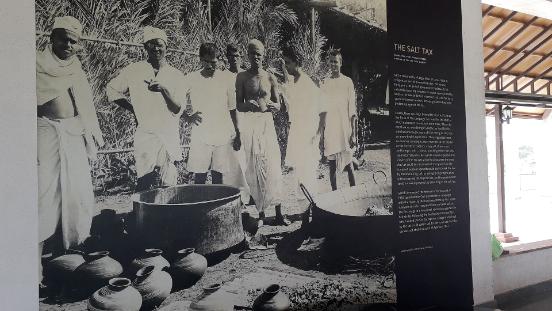
But let there be not a semblance of breach of peace even after all of us have been arrested. We have resolved to utilize all our resources in the pursuit of an exclusively nonviolent struggle. Let no one commit a wrong in anger. This is my hope and prayer. I wish these words of mine reached every nook and corner of the land.
--Mahatma Gandhi, Speech on the Eve of the Historic Dandi March.
On March 12th, 1930, Indian lawyer and anti-colonialist Mohandas Karamchand Gandhi challenged the salt tax imposed by Britain by leading a 240 mile non-violent protest from Sabarmati in Ahmedabad to Dandi in the Navsari district of Gujarat (then Navsari). The march that began with 78 volunteers or satyagrahis, including persons of every region, caste, creed, and religion of India, lasted 24 days and was joined by growing numbers of participants who beat drums, struck cymbals, slept in the open, and began making salt along the shore -- leading to the arrest of Gandhi and the jailing of over 60,000 Indians. To break the salt monopoly, Gandhi encouraged salt manufacture, when possible; possession and sale of contraband salt, including natural salt or salt earth; and the taking and hawking of natural salt deposits.
A vital mineral compound and essential for life, and symbolic of a covenant bond, salt was a significant metaphor in the movement towards an independent India and one that addressed social and political injustices. The Salt March gained international attention; was widely covered by media; and influenced civil rights leaders, including Martin Luther King, Jr., in following decades.
The term "salt of the Earth" references the high value of salt and is often used to describe someone who is honest, trustworthy, loyal, and hardworking. Gandhi's honorific first name, Mahatma (meaning great-souled or venerable), was first given to him in South Africa where he lived and led peaceful campaigns over twenty one years before he returned to India in 1915 to organize protests against discrimination and land taxes.
The following articles are drawn from Proquest Historical Newspapers, which informs and inspires classroom teaching and learning.
- Brisbane, A. Today... Smallpox Also Marches. March 12, 1930 (page 1 of 32). (1930, Mar 12). The San Francisco Examiner (1902-2007)
- The Disobedience Crusade. (1930, Mar 25). The North - China Herald and Supreme Court & Consular Gazette (1870-1941)
- Women Now Volunteer to Defy India's Salt Laws. (1930, Mar 30). The China Weekly Review (1923-1950)
- Gandhi's Salt Revolt Stirs Up Riots in India: Police Seize Followers; He Remains Free. (1930, Apr 07). Chicago Daily Tribune (1923-1963)
- Daily Picture Page of World's Latest News Events. (1930, Apr 08). The Hartford Courant (1923-1995)
- Gandhi Finishes Salt Tax Stunt. (1930, Apr 26). The Pittsburgh Courier (1911-1950)
- Gandhi Wasted to 96 Pounds by 8 Months in Jail: Homely Man. Barely 5 Feel Tall, Sways India by His Power of Dramatization Began Defiance in 1903 Led South African Campaign on British Discrimination. (1931, Jan 26). New York Herald Tribune (1926-1962)
- Through Nationalist Eyes: An Eventful Week. (1934, Apr 11). The Times of India (1861-Current)
- The Life of Gandhi-- a Non-Violent Struggle for Indian Peace and Independence. (1948, Jan 31). New York Herald Tribune (1926-1962)
- McCarthy, C. (1969, Oct 01). Mahatma (Maha: Great; Atman: Soul). The Washington Post, Times Herald (1959-1973)
- Kaufman, M.T. (1980, Apr 07). Few Mark Gandhi's 1930 March to Sea: Used Nonviolence as Weapon; Gandhi Bathed in Sea; Two Views of Gandhi. New York Times (1923-Current File)
Tips:
- Allen, Douglas. Mahatma Gandhi. 1st ed., Reaktion Books, 2011. e-book.
- Griffing, Brenda. The Power of Protest : A Visual History of the Moments That Changed the World. 1st ed., Sourcebooks, 2018. e-book.
- Miller, Derek L. Mahatma Gandhi : March to Independence. 1st ed., Cavendish Square, 2018. e-book.
- O’Brien, Anne Sibley, and Perry Edmond O’Brien. After Gandhi : One Hundred Years of Nonviolent Resistance. Charlesbridge, 2010. Curriculum ; HM1281 .O33 2009.
- Wolpert, Stanley. Gandhi’s Passion : The Life and Legacy of Mahatma Gandhi. 1st ed., Oxford University Press, 2001. e-book.
Images:
- National Salt Satyagrah Memorial, Dandi, by Sushant Savla, 2019. Wikimedia Commons.
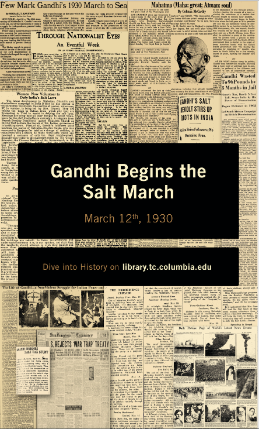
- Collage of Newspaper Images, 2021. Gottesman Libraries.
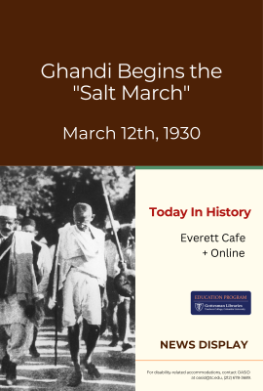
- Poster Image: Gandhi During the Salt March, 1930, Wikimedia Commons.