Exploring "Disability Joy" and Evolving Frameworks for Academic Credit
How Collaborating with Student Researchers Reshapes the Way We Value Academic Labor
It is fulfilling to follow a student’s research journey from the initial stages of brainstorming and formulating ideas to final publication and the sharing of new knowledge with the public.
Today, I am highlighting a recent book chapter co-authored by Dr. Sandra Schmidt, Associate Professor in the Program of Social Studies Education, and Jasper Golden, a PhD student in the Program in Social Studies Education. Their chapter, “Disability Joy: Producing Supportive Curricula for D/disabled Students through a Framework of Historical Materials from Camp Jened,” appears in the newly published Handbook of Critical Special Education: Research, Policy, and Practice (edited by E. B. Claravall & A. L. Ferrell).
The chapter explores how the concept of "disability joy" can be integrated into school curricula, specifically K-12 social studies, to counter the historic marginalization and erasure of D/disabled youth.
Jasper and I worked extensively together during his literature review process, collaborating to identify relevant research to contextualize and inspire this work. Because of this firsthand collaboration, it is especially powerful to see how the final chapter serves as a living example of how knowledge production thrives on a multitude of voices, rather than relying solely on a singular authorial perspective.
From the outset, Golden and Schmidt intentionally ground their work in cooperation and community. Borrowing from scholar S. Schalk (2022), they echo the inclusive spirit that characterizes critical disability theory, dedicating the chapter to:
“Anyone who is D/disabled, for those who care for D/disabled people, for anyone who is interested in dis/ability, for anyone who is in community with someone D/disabled, and for those who educate and mentor our D/disabled students."
Rejecting how academia typically elevates the voices of "experts", Golden and Schmidt position themselves as part of an active dialogue between “Disabled and Non-Disabled scholars.” Crucially, they center the historical perspectives of teenagers themselves, analyzing newsletters written by campers at Camp Jened between 1966 and 1971. The archival content used to theorize disability joy ranges from high-stakes sports write-ups to deeply personal editorials on societal acceptance and comes directly from the teenagers' own creativity, resilience, and self-expression. By bringing these archives (and the stories they preserve) into the classroom, the project bridges the gap between youth activists of the 1960s and 1970s and today’s students.
It was a true pleasure to be one of the many people supporting this project. Witnessing its publication has also caused me to reflect deeply on how we attribute value and credit in academic research.
A Reflection on Credit, Collaboration, and Library Partnership
It is often said in our field that the library is a partner in research, not just a service provider. We see this every day as students and faculty publish after partnering with us—whether we helped locate an elusive text, refine a complex research question, or provide the frameworks for a rigorous literature review.
Yet, traditional practices around academic credit don't always reflect this cooperative reality. Systemic ownership is heavily tied to the authorship model, where even the order of names (first, second, or third author) is tightly scrutinized as a metric of contribution. In reality, we know that an immense community goes into knowledge production well before a citation is generated: mentors, teachers, peers, library staff, editors, community members, friends, neighbors...
Other industries handle this ecosystem of labor differently. In software development, open-source projects give granular credit to every contributing engineer via Git logs. In the arts, conversely, teamwork is often made entirely invisible to the public, keeping the focus strictly on a singular artist or brand.
Fortunately, there are growing efforts within academia to evolve the way research credit is expressed, moving toward frameworks that capture the nuanced, collective ways we build knowledge together.
For instance, the Contributor Role Taxonomy (CRediT) is a community-owned framework designed to represent the collaborative nature of modern research:
“CRediT is a taxonomy of 14 contributor roles designed to represent the key types of contributions typically made to research outputs, including journal articles. Originally developed to complement traditional authorship by capturing the diverse contributions behind published research, CRediT provides a structured way to describe how research is produced. While rooted in scholarly publishing, the value of contributorship information extends more broadly to support research assessment, expert discovery, research integrity, and accountability.” (From the CRediT website).
The taxonomy schema is as follows:
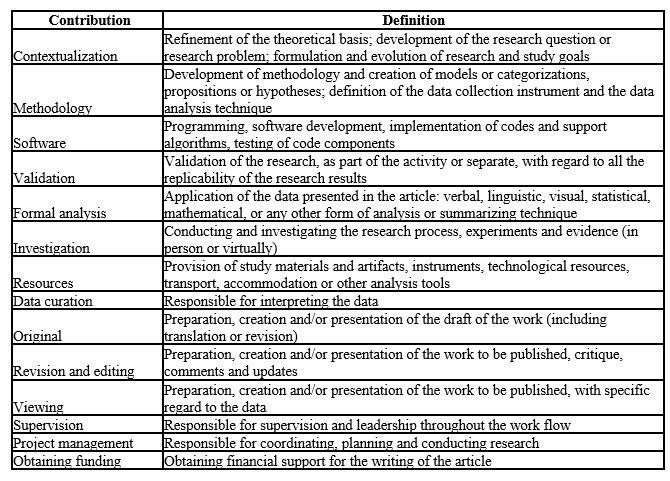
Image credit: https://credit.niso.org/
Until structural frameworks like CRediT become standard across all disciplines, the “acknowledgments” section remains one of the most powerful tools scholars have to "shout out" the ecosystems and people that sustained them and their work.
Just as Golden and Schmidt advocate for the multi-generational "care web" of disability community and scholarship, we at the Gottesman Libraries want to celebrate the shared, collaborative networks that allow academic research to flourish.
Check out the digital chapter via Educat+! https://teacherscollege.primo.exlibrisgroup.com/permalink/01TCCU_INST/1uje495/alma991006743996306971