Today In History: Announcing 12 New MA's from New College, Teachers College
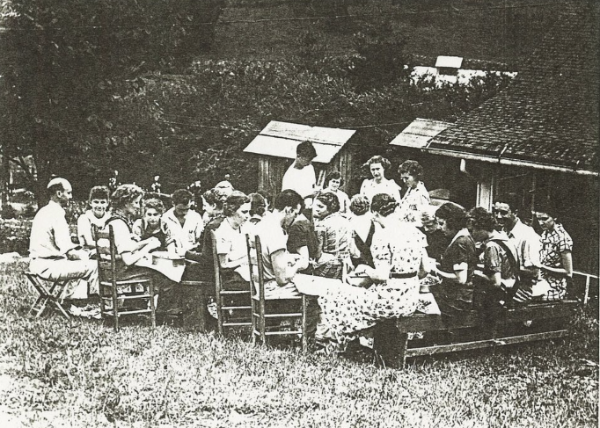
We have only been awakened to the complexities of this world and, in talking, we wondered how important a thing this was to have happened ... ... for us, for our generation, and for the generation we have been taught to teach.
On May 31st, 1937, the following students were announced in the New York Herald Tribune as the recipients of the first Master of Arts Degrees from New College of Teachers College, Columbia University: Edith J. Goldbloom, of Brooklyn; Abdul Hamid Kadhid, of Bagdad, Iraq; Mahammed Hasir, of Abdul-Khasib Basrah, Iraq; Theona Rothermel, of Nichols, Connecticut; Harold E. Tannenbaum, of Newburgh, New York; Bernard V. Werthman, of Bradford, Pennsylvania; Louis Brown, Ramsay Wood and Jane W. Welles, all of New York City; Joan Demenholz, of Brooklyn; Martha Connalock, of Newark, New York; and Mary Jane Hungerford, of Harmon, New York. Their degrees were awarded the following day at convocation ceremonies in Morningside Heights, New York, though the last six graduates were eligible for degrees in December 1936 having completed their studies.
While this number seems small, it is monumental in the context of the history of New College, which was established in 1932 under the pioneering work of Dr. Thomas Alexander as an experimental unit of Teachers College, Columbia University where progressive teaching and learning were highly valued. New College was originally designed to serve as an undergraduate school with courses leading to a Bachelor of Science, and then it added a master's degree for students undertaking a period of study from three to five years. It is interesting to note the enrollment of foreign students at New College, reflective of Teachers College deep and historic international interests that stemmed from the founding of the International Institute of Teachers College by Professor Paul Monroe and Dean James Earl Russell in 1923; they sought to deepen international education and comparative studies of educational philosophies, practices, conditions, and systems in different nations.
An expert on European education, and especially German education, Thomas Alexander sought to build a liberal arts curriculum that was conscious of social needs and issues and addressed real-world living. Among his colleagues were: Florence Stratemeyer, Paul Limbert, Peter Sammartino, Winnifred Bain, Agnes Snyder, and John Taylor. Together they infused farming, foreign study, internships, the arts, and much more -- launching an entirely new and attractive approach, that was partly based in rural North Carolina and Georgia to replace the rigidity of the formal campus classroom and inspire future generations of teachers. Financial challenges led to the disappointing closure of New College in 1939, and Thomas Alexander spent his post-war years working under General Lucius Clay in the Education and Cultural Relations Division of the Office of Military Government for Germany.
The following articles are drawn from Proquest Historical Newspapers, which informs and inspires classroom teaching and learning.
- Columbia Will Open New College in 1932: Demonstration and Experimental School for Teachers will Foster "Creative Leadership." ''New Race" of Instructors, Dr. Alexander Says Training Must Be Altered Radically to Meet Education Problem. Course to Be 3 to5 Years. Curriculum Will Include Foreign Study and Work in Industry."Internship" to Be Required. (1931, Oct 04). New York Times (1923-)
- Snyder, A. (1932, Aug 21). New College Is a Pioneer: Unit for Teachers to Try Novel Study Plan -- A City as Laboratory. New York Times (1923-)
- Teaching Class to Get Summer Term on Farm: New College Students of Columbia to Study on North Carolina Acreage Will Get Plenty of Work : Educational Experiment Is Held Success in 1st Year. (1933, May 22). New York Herald Tribune (1926-1962)
- New College Adds 150 to Enrollment: Columbia School will Have 300 Students This Year -- Registration Tomorrow. Experiment a Success. Unusual Course of Study Is Expected to Revolutionize Methods of Teaching. (1933, Sep 17). New York Times (1923-)
- 12 to Receive M. A. Degrees of New College: ... at Columbia to Send Forth First Accredited Graduates, Previous 5 Were Recalled : Course Dispenses with All Marks and Class Units. (1937, May 31). New York Herald Tribune (1926-1962)
- Modern Trends in Education: Teachers College Organizes New Center in South: School in Georgia Will Seek to Adapt Education to Needs of Typical Rural Community: Students from New College Here Will Do Apprentice Work There; Rotating Homesteaders Will Be Invited to Learn Scientific Methods of Farming While Cultivating Institution's Property. (1937, Oct 17). New York Herald Tribune (1926-1962)
- Will Head New College: Dr. D. G. Tewksbury to Succeed Dr. R. T. Alexander. (1938, Jan 15). New York Times (1923-)
- 9 New College Students Off for Community Study. (1938, Jun 19). New York Herald Tribune (1926-1962)
- Columbia to Close Its New College: Funds Lacking, Experiment as Unit of Teachers College Branch Will End in June. $57,000 Deficit Last Year. faculty and Students Are Stunned -- Some Criticize the Move as "Undemocratic". Reviews College's History. (1938, Nov 11). New York Times (1923-)
- Russell, W. F. (1938, Dec 04). Decision to Close New College Stirs Regret and Sharp Protest: Educators Laud Aims and Results of Experiment--Alumna and Student Attack Action--Dean Says 'Idea Will Not Die'. New York Times (1923-)
Tips:
- Burrows, Raymond. Elementary Piano Instruction in New College and Teachers College. Teachers College, 1936. TCANA ; MT18 .B8 1936.
- New College Collection. Demonstration and Experimental Schools. Teachers College Digital Collections.
- New College, for the Education of Teachers in Teachers College, Columbia University, for the Year Beginning. Teachers College, Columbia University, 1933. TCANA ; LD1233 .A3.
- Snyder, Agnes, and Thomas Alexander. Teaching as a Profession : Guidance Suggestions for Students. New College, Teachers College, Columbia university, 1932. TCANA ; LB1775 .S6 1932.
- Thomas Alexander Collection. Demonstration and Experimental Schools. Teachers College Digital Collections.
- We Asked the Mole. New College, 1939. TCANA ; TCN Q5.
Images:
- NCC Bean Seminar 1936-Limbert on Left. Thomas Alexander Collection, Courtesy of Teachers College, Columbia University.
- NCC Community 1930’s. Thomas Alexander Collection, Courtesy of Teachers College, Columbia University.