Honoring a career that has shaped education systems across five continents
150+
Publications
8
Books Published
30+
Countries Advised
Kobe University, Japan
Graduate School of International Cooperation Studies
Teachers College, Columbia University
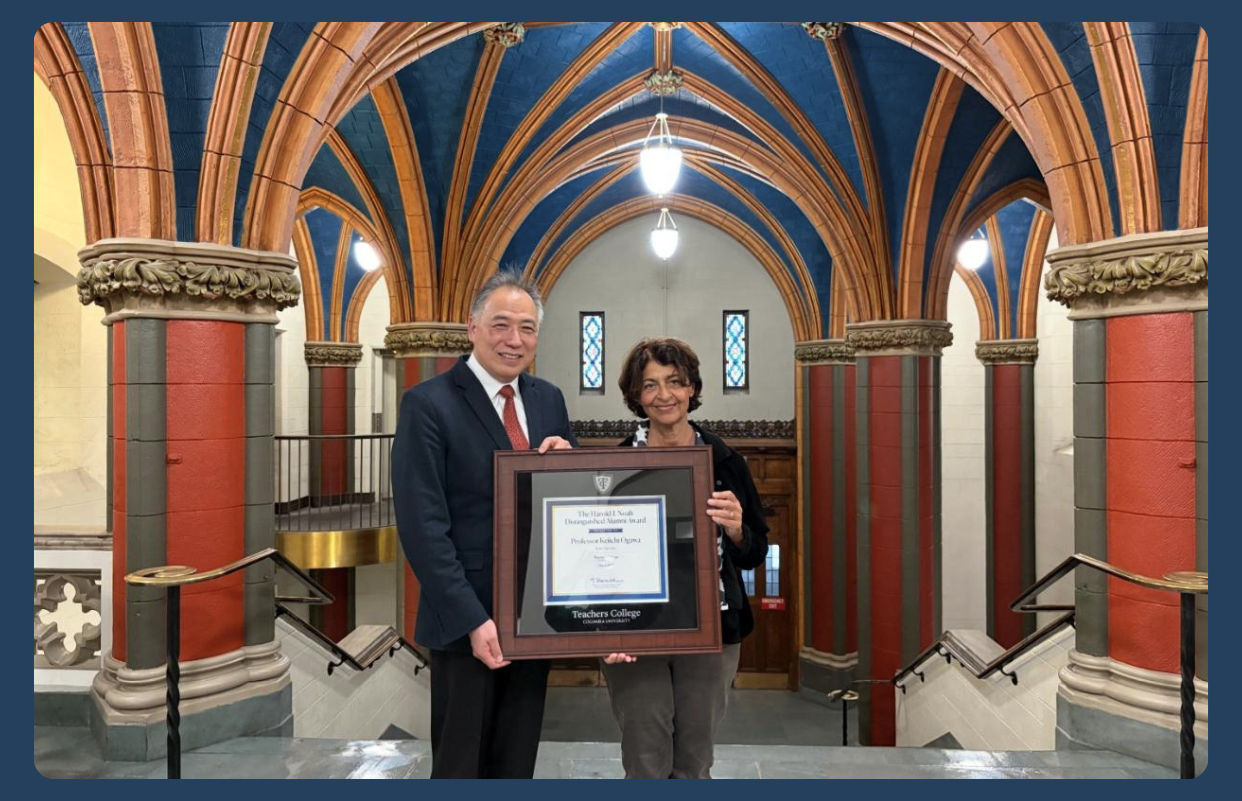
At the CIES 2026 Annual Conference in San Francisco, Professor Keiichi Ogawa of Kobe University was awarded the Harold J. Noah Distinguished Alumni Award, the highest recognition presented by the International and Comparative Education program at Teachers College.
The award, named for Harold J. Noah, a central figure in the development of comparative education, recognizes alumni whose work has made a sustained and meaningful contribution across research, policy, and practice. Over the past two decades, Ogawa has built a career that reflects that vision at a global scale.
After earning his doctorate from Teachers College in 1999, Ogawa began his career at the World Bank, where he engaged directly with education systems in transition. He later moved into academia, joining Kobe University in 2007, where he has since developed a significant body of scholarship examining education systems, reform, and development.
His work now spans more than 150 publications and 8 books, contributing to key debates in international and comparative education. What distinguishes Ogawa’s career is not only the volume of his scholarship, but its reach. He has advised governments and international organizations in more than 30 countries, working across diverse contexts to support policy development and system-level planning.
His engagement bridges research and practice, connecting academic insight with real-world application. In parallel, Ogawa has contributed to global education planning through his work with the UNESCO International Institute for Educational Planning in Paris.
His leadership within professional associations, both in Japan and internationally, has also helped strengthen networks across the field and expand opportunities for collaboration.
Colleagues consistently point to his commitment to mentorship as a defining feature of his work. His doctoral and master’s students have gone on to roles in academia, government, and international organizations, extending his influence well beyond his own research.
Through both scholarship and teaching, Professor Ogawa’s impact continues to shape the field across generations.