Woodworking and When Playing Around Becomes a Serious Craft



Listen to Episode
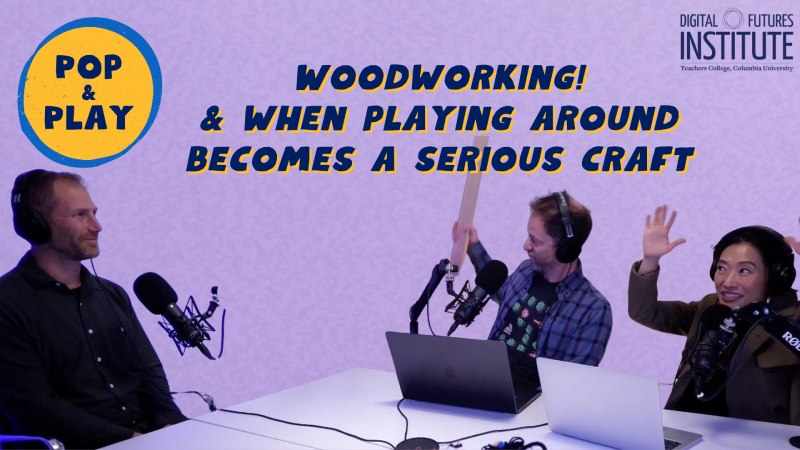
How do you know when what you started playing around with has become a serious craft? This week Haeny and Nathan talk with Professor Bryan Keller about his passion for woodworking that has grown some deep roots.
Bryan Keller is an applied statistician and Associate Professor of Practice at Teachers College, Columbia University, where he directs the programs in Measurement, Evaluation, and Statistics. His research focuses on the development and application of statistical methods for research, especially in education, health, and psychology. Learn more at his faculty webpage https://www.tc.columbia.edu/faculty/bsk2131/
Our music is selections from Leaf Eaters by Podington Bear, Licensed under CC (BY-NC) 3.0.
Pop and Play is produced by the Digital Futures Institute at Teachers College, Columbia University.
Credits: Video and audio for this episode were recorded by Joe Riina-Ferrie. This episode was edited by Adrienne Vitullo and Billy Collins. Website support by Abu Abdelbagi. Pop and Play is produced by Haeny Yoon, Nathan Holbert, Lalitha Vasudevan, Joe Riina-Ferrie, and Billy Collins and is part of the Digital Futures Institute Podcast Network at Teachers College, Columbia University.
The views expressed in this episode are solely those of the speaker to whom they are attributed. They do not necessarily reflect the views of the faculty, administration, staff or Trustees either of Teachers College or of Columbia University.
Episode Transcript
Nathan:
Welcome to Pop and Play, the podcast all about play and pop culture and how it shapes our lives. I'm Nathan Holbert, and with me as always is Haeny, I'm not a Ficus, Yoon.
Haeny:
Okay, sorry. Today we've got another play date and you'll realize why Nathan just said that punny joke. A new segment of pop and play episodes where we invite you to play along with us. Each play date will choose a play experience, let you know in advance what we're up to, and then invite a guest to help us reflect on why this particular form of play matters.
Nathan:
That's right. And for this month's play date, we got into woodworking. We smelled trees, we measured twice, we cut five, maybe six times, and we did all of this with today's guest, Bryan Keller. Bryan Keller, associate professor of practice and applied statistics at Teachers College. And might we also add, New York City Marathoner and local high school wrestling referee. Welcome, Bryan.
Bryan Keller:
Referee in training.
Nathan:
Well, we're hoping when the time this comes out, you've passed all your tests.
Bryan Keller:
Oh yes, that's true. That's true. And thanks. Yeah, happy to be here.
Haeny:
Great. So Bryan is our local woodworking enthusiast/expert.
Nathan:
I'm going to call him an expert.
Haeny:
Okay. Despite all the ways that he tells us he's not. We actually went to go witness this and we realized it is definitely more than a hobby.
Nathan:
More than a hobby.
Haeny:
And so we went to his house a few days ago to see how he got into this hobby and what it feels like to be into woodworking.
Speaker 4:
[inaudible 00:01:32].
Bryan Keller:
Yeah, I'm not an expert because I have all five fingers on both hands.
Haeny:
Oh, you have to lose a finger to be an expert.
Bryan Keller:
At least partial. Yeah.
Haeny:
That's the kind of hobby I do not want then.
Nathan:
There's a limit to my interest in being an expert here.
Haeny:
Yeah, exactly.
Nathan:
Well, we had a lot of fun hanging out with you in the furthest reaches of New York I might add.
Bryan Keller:
Yeah. Right on the New Jersey border.
Nathan:
Right on the edge.
Bryan Keller:
Stones throw from New Jersey.
Nathan:
We were in danger of falling into New Jersey the whole time we were there.
Haeny:
It took us 30, maybe 35 minutes to get there. It's hard.
Nathan:
But we're excited to have you here in the studio today to talk about your hobby, to talk about what it means to play with wood and woodworking. Before we get into the good stuff though, we always like to start with a game. And we're going to do sort of a classic wait, wait, don't tell me type of game. Are you familiar with that podcast or that show, radio show?
Bryan Keller:
Yeah.
Haeny:
What is it? Tell us.
Nathan:
Well, it's a radio show where they have a bunch of comedians going through the news and they just make jokes. And it's a delight. Peter Sagal hosts it. Filmed in Chicago, in fact.
Haeny:
Wait, wait, don't tell me. I have a mug. I know what it is.
Nathan:
And why did you ask?
Bryan Keller:
Carl Kasell and now Bill Curtis.
Nathan:
Yeah. Well, I'm stealing this idea from them, and so here it is. You're an expert in woodworking, but how knowledgeable are you about celebrities with names related to wood?
Bryan Keller:
Of course. I see the connection. It makes perfect sense.
Nathan:
So I'm going to give you a scenario or a statement and I'm going to invite you to try to tell us the name of the celebrity that this is a reference to.
Bryan Keller:
Okay. I see myself crashing and burning on this, but let's give it a go.
Nathan:
If it gets bad, we'll do our best to help. I think I'm starting with an easy one, but you know, we may find out I'm wrong. All right, here we go. This tough wood has happy feet, is a good son, and can take a skewering from a mountain troll without so much as a scratch.
Bryan Keller:
Oh. I mean, troll, I'm thinking Shrek, but I'm off base here.
Haeny:
I'm not going to lie, I have the answer right in front of me and I don't even get it.
Bryan Keller:
So a penguin. I remember a song related to this, but yeah.
Nathan:
In one of his movies, there are trees that actually walk and talk really slowly.
Bryan Keller:
Well, that makes me think of Ents from Lord of the Rings.
Nathan:
Yes, yes. And this wood...
Bryan Keller:
The hobbit?
Nathan:
Looking for an actor's name.
Haeny:
You have to tell us about the wood name.
Bryan Keller:
Oh, Elijah Wood.
Haeny:
Yeah.
Nathan:
That was tough.
Haeny:
This i a peek into Nathan's brain.
Nathan:
Okay, how about this one? Irons are useful clubs for mid and short distance precision. This wood was a master with an iron.
Bryan Keller:
Oh, this one's a slam dunk, Tiger Woods.
Haeny:
Yeah.
Nathan:
I should have started with that one. That would have been the easier one perhaps.
Haeny:
I think you should do the last one.
Nathan:
Should I do the last one?
Bryan Keller:
The pressure's on.
Nathan:
This is it. This is your chance to really bring it home. You just want me to read the clue?
Haeny:
Yeah, I think it's kind of awesome. And we could end on a high note because he'll get it right.
Bryan Keller:
Oh, now there's even more pressure.
Nathan:
All right, here's the clue. Our woodiest U.S. president was also the only one with a PhD.
Bryan Keller:
Woodrow Wilson.
Haeny:
See, I told you. Predicted it, nailed it.
Bryan Keller:
I didn't know that about the PhD.
Nathan:
Yeah. Well, thank you very much, Bryan, for playing along with us on this game. I hope we didn't cause too much stress, but you did excellent.
Haeny:
You did an excellent job. Okay, so I'm going to start us off. So I am going to relate this to what my life has been like the last year or so is I have been trying out a bunch of weird little interests or hobbies and things. So sometimes I take a class, sometimes I look at YouTube, sometimes I do all these other things. And some things stick and hit and some things are like, okay, I tried it. I'm done with it.
Bryan Keller:
You're good.
Haeny:
Yeah. So let's say someone is intrigued by the idea of getting into woodworking. What's a good place to start? Like a low lift that gives them maximum feeling of success?
Bryan Keller:
Yeah, I think it probably depends on what they're interested in working with wood for. Are they interested in working with it to improve their home or to make a gift for somebody or to make a bookshelf? So there's lots of different ways that you can get engaged, but I think it probably depends on what your ultimate goal is.
Haeny:
How did you start?
Bryan Keller:
So I started really thinking about it when we bought our house out in Rockland County. And we got there and we had all these trees that had to come down and they were old, sometimes 80 to 120 years old, oak and black locust and other species. And just seeing them get chopped down and taken off to the chipper. And meanwhile, we were thinking about doing built-in bookshelves in one room and other stuff, so I was like, "Maybe we could use some of this." And then we'd have not only be able to reuse or use the wood, but also have a story about it. So I had a guy with a sawmill come out to my property, I hired him and was just like blown away, just turning a huge oak log into basically beautiful lumber. And so that's how I got started.
And doing that and then thinking about, wow, I have this resource all around me, not only in my yard, but the neighbor's yards, and so now I'm that guy who, when I'm out walking my dog, if there's like a tree crew that shows up somewhere, I'm like, "Hey, what do they do?"
Haeny:
It's right there. "What are you going to do with that?
Bryan Keller:
Yeah, you guys got plans for that?
Nathan:
Can I have them?
Bryan Keller:
Yeah. And it sort of translated into me wanting to use the wood for building materials for projects on my property.
But I think that more broadly, let's say you want to get into woodworking because you're interested in making gifts for people or making boxes or shelving, the first thing that you probably want to do is, depending on where you're at and what kind of space you have, like in the city, I know people in Brooklyn, they have shared spaces where you can kind of join like a cooperative and then show up to the shop on a certain day. You sign up and there's a table saw and a chop saw and a planer and all this stuff. So if you're in a place like that, then you can maybe get into something like that. Otherwise, you probably want to get some kind of a saw.
Nathan:
You need to get [inaudible 00:09:03].
Haeny:
And keep all your fingers.
Bryan Keller:
Keep all your fingers. And then I think probably the next step after like a table saw would be like a planer, and that's the thing that can take rough cut lumber and really make it pop. No pun intended.
Haeny:
So planer is like a big machine, right?
Bryan Keller:
It's not huge. I mean, you can buy cheap ones for 300 bucks that are like of questionable quality.
Haeny:
That are like tabletop-ish.
Bryan Keller:
Tabletops, yeah, like the Teemo versions or whatever. But you can buy like the nice DeWalt planer for probably 700 bucks and then you can just run boards through it and they look amazing. So yeah, depending on what you want to do, you need a table saw, you maybe need a planer and you need some space to work.
Nathan:
You mentioned the planer and how it can make wood look amazing. And I'm pulling out our board, Haeny, this is our board.
Haeny:
Thank you. Yes, our board.
Nathan:
We made this board from rough cut lumber with Bryan's planner at his house and it-
Haeny:
Look how smooth it is.
Nathan:
.. feels great.
Haeny:
Knock on wood.
Nathan:
The connection between all the episodes. The fun thing about this is when we got back from this, I was like, came to my wife Hannah, I was like, "Hannah, look what I made." And she's like, "It's a board." I'm like, "Yeah, it's so cool, right?" And she's like, "Yeah."
Bryan Keller:
Congratulations. Yeah, this is a piece of black locust and this is one of the species that, if I can geek out for a second-
Nathan:
Please.
Bryan Keller:
... really motivated me to get interested and sustains my interest in wood and local wood. This is an amazing species because it is super rot resistant. It's super dense. People use it all over the world for firewood. It's one of the hottest burning woods that's native to North America that's not like a niche, that grows widely in a lot of areas. And it was used for years in boat building and for fence posts, just because you can, and I was telling you about this when you were at my place, but you can take some of this, a piece of firewood and bury it and then come back three years later, pull it out and knock on it and it sounds like that. Yeah, it's not punky.
And so I'm using it for siding, for posts and for decking on a building that I'm building, the sauna building that I'm building at my place. So I'm really excited about, to the point of being a little bit obsessed, my family makes fun of me, my friends make fun of me. I know where all the black locusts are in my neighborhood.
Haeny:
You're just waiting for someone to give it to you.
Bryan Keller:
Yeah, I keep an eye on them.
Nathan:
Were you hoping that the quiz that we were going to give you at the game at the beginning was going to be like, "Where's the black locust on?"
Bryan Keller:
Yeah, it's like a street, a squirrel with nuts. Yeah.
Haeny:
Yeah.
Bryan Keller:
But yeah, New York is full of these. And they tend to grow in the dejected inter highway spaces that no one's... they love poor soil. They are real hearty. They're nitrogen fixing, so they improve the nutrition of the soil. And that's one of the reasons in addition to the wood quality is that they've been sort of transplanted all over the world. I went to a conference, I was invited by a colleague in Seoul at Seoul National University to go to a conference there, and I went and presented and he took me out to the woods on Gwanaksan Mountain, which is up high. And as we were walking out there, it was like, black locust, black locust. And I was just freaking out and he's like, "What is your problem?"
And I actually got into a conversation, because I was talking about it, somebody walking by who was from SNU was like, "Oh yeah." And we stopped and had a conversation. She's telling me about the history of how they brought it over to try and reforest that area after certain conflicts had made, the war had made the hillside kind of barren and the soil quality poor. And now it's invasive and it is considered invasive in some areas in New York.
Nathan:
Interesting.
Bryan Keller:
It is interesting and it works well for me because no one cares when you cut them down.
Nathan:
Well, I want to ask you a little bit more about that, because this is also something that struck me whenever we talked at your house the other day. I used to be a chemistry teacher, I was a high school chemistry teacher for many years and despite the fact that I haven't been involved in the world of chemistry directly for a long time, I still kind of have a hankering for those types of topics. And when you started talking, immediately there was like all this chemistry involved. You even said already about the way it interacts with the soil and the nitrogen. And then you were showing us some of the different pieces of wood in your home and how they get this sort of different coloration and these different kind of patterns based upon the chemistry of the wood as it reacts to beetles that get on it. That to me was like blowing my mind.
Bryan Keller:
Oh yeah, the Ambrosia maple. Yeah.
Nathan:
And it seems like that is maybe a part of the thing that also got you involved in this too.
Bryan Keller:
Yeah, totally. It's like you just look at the trees and don't think about them. They're kind of a nuisance in your yard. But then when you take them down and open them up, this world opens up and you can kind of use them in all these different and interesting ways.
So one of the things about like locust too is that it's, I don't know how to say this, I think it's allelopathic. So it has some compounds in it that inhibit other plants from germinating around it. But talking about chemistry, like, yeah, what kind of chemicals is it using to specifically target like soft root growth and seed germination around it? There's like a cocktail in there. And it's full of these tannins that prevent fungus, mold and insects from degrading it. So it was planted up and down Cape Cod and all along the coast from its native areas just because it never degrades so it was used in boat building.
Yeah, I think that's really interesting and it's part of what I think gets people passionate about using different kinds of woods. Like maple, you can get spalting, which involves fungus intrusion, but it looks beautiful. And then the properties like, so locust has these tannins that make it really, really robust, but also things like white oak also and black walnut. Sassafras to some extent also does. And a lot of people use western red cedar for outdoor applications. Like that's the thing that you think of, I'm going to use outdoor.
But really, when you're thinking of like decking or outdoor wood, it's kind of like, you know, if you're going to build a deck, what are you going to use? You're going to either use like the plastic stuff like the tracks or you're going to use treated lumber, which is like pine or dug fur that's infused with a bunch of chemicals under pressure, like toxic stuff. Or you're going to buy ipe or teak, but those aren't really sustainable. And locust is something that is as rot resistant as ipe and teak, but it grows here. It's considered invasive and it's everywhere. So it's like, I think it's something that for sustainability purposes and for just taking advantage of a natural resource is really kind of cool.
But yeah, the chemical composition is not something I know a ton about, but it is what leads to, I think, what makes me fascinated by the different characteristics of wood.
Haeny:
I just had a revelation/thought.
Nathan:
Nice.
Haeny:
Because I really appreciate the way that you're telling the story, because your interest in it really came from a practical purpose and a reason, right? Like I just moved into this house, I have all these built-ins that I'm going to have to put in. I saw this person come with the saw and I was really fascinated by all this lumber that was out there and there was an intersection of this really practical need to do something and then how that led to you exploring parts of wood that you weren't necessarily, you didn't start with that purpose. You didn't start with the purpose of getting into the science of wood and thinking about nature and thinking about sustainability, which I think is really cool.
And I feel like a lot of times when we talk about play and kids, we're always like, the practical, functional, utilitarian part needs to be disentangled from the play part of it, right? Or we think we just need to fulfill the practical purpose and then not let it extend or go even further. And I think about that with, like immediately what comes to mind is like reading, right? We need to teach them the fundamentals and the practical part of it and that practical part of it is the reason why we might all want to read, right? But then there's deeper and more exciting things that could come from that initial inquiry, right?
So I don't know. It's given me a lot to think about. I think that people play for functional utilitarian reasons, but people play also for creativity and expanding.
Bryan Keller:
Yeah, totally. I think that both of those are part of why I'm engaged in this process. It also gives me a way to connect with my surroundings, that's important to me. And it's a good excuse to buy more tools.
Haeny:
Yeah, exactly.
Nathan:
Yeah, I'm not going to lie, I was a little disappointed when Haeny asked how to get started and you told me that I shouldn't get like a whole mill. I don't know what I'm going to tell my wife now.
Bryan Keller:
I told you guys, I couldn't believe my wife let me buy that mill. It was after I had taken on like a new consulting job, so I got like a nice 1099 check.
Haeny:
And you're like, "This is what it's for.
Bryan Keller:
And I was like, "This is not part of the normal budget." The other way that I think about the finances of it is how much would it cost to side the building in cedar? And cedar is so expensive. The good stuff is so expensive and so if I think about that and like I can get all this locust for free, I mean it's a lot of time, right? But I'm not paying, I mean in the sense I am, it's opportunity costs, but I'm enjoying it.
Nathan:
Like I'm saving money.
Bryan Keller:
Yeah, exactly.
Nathan:
I'd be crazy not to buy this huge mill.
Bryan Keller:
Yeah, right.
Nathan:
Yeah, we'll try to share a picture of it in the show notes, but it's about a Haeny and a half tall, and it's about three-
Haeny:
That's pretty tall.
Nathan:
... three to four Haenys long.
Bryan Keller:
Yeah. It's a Woodland Mills HM130. So it cuts logs up to 30 inch diameter, which is plenty for what I need.
Nathan:
How many Haenys is that? That's our metric system here.
Bryan Keller:
An 8 foot log that's 30 inches around is going to be more than a thousand pounds. So that's a bunch of Haenys.
Haeny:
Oh my goodness.
Nathan:
It's a lot of Haenys.
Haeny:
Wow. I like this new metric system.
Nathan:
So another thing we wanted to ask you about, we have been finding, especially on these play dates when we've been engaging with people around activities that they like to play in, one thing that we see as kind of a consistent theme is the role that communities play in how we gain expertise certainly, but also like how we enjoy these things and how we get into them, how we learn in those spaces. And I'm wondering how community has played a role or what that community looks like for you as you've gotten involved in woodworking, right? For example, anytime we'd refer to you as an expert, you'd be like, "Well, I'm not an expert actually." These other people that are experts.
Other than number of digits on your hands, how do you kind of see yourself in a community? What are the communities that you engage in? Are there local communities you get involved in? Is it online communities? How does that work with you?
Bryan Keller:
Yeah. So for most of the, I guess learning that I'm doing, it's through online. So I'll be watching YouTube videos. I actually use ChatGPT a lot to learn about, just asking it questions along the way and it's usually pretty good because it's pulling from, there's a lot of stuff online, Reddit forums and woodworking forums and it just has access to all this information.
In terms of like actually interacting with real people, which is probably more pro social and better for your life, I think it's been less like finding a community of experts around woodworking and more just been a focal point to bring people together who have a shared interest. So for example, a friend of my son's, one of his best friend's fathers had picked up a piece of walnut from, like a discarded carpentry shop piece, and was interested in making a table out of it, but it was too thick and he needed two pieces, and he knows I got the mill. So he came over, he brought a six pack, we cut the board in half, had some good conversation and I feel good because I'm helping out and it brings people together. It's a reason to come together.
There's two friends I have that are carpenters that we work out together regularly. One is Caleb with the missing index finger, and the other one, Dom, who is like an apprentice carpenter. And whenever we're working out, we're talking about, we're sharing pictures of our projects and I've been over to his place to help him with stuff. They've come over, and Caleb helped me put the mill together.
So there's definitely social aspects to it. I wouldn't say that I'm like involved in like a woodworking community. It's more like-
Haeny:
You're not in Woodworkings Club America.
Bryan Keller:
Yeah. And there are those things, right?
Nathan:
Membership cards.
Bryan Keller:
Yeah. I'm sort of idiosyncratic in the way that I think I engage with it because I'm not building like boxes or like the typical kind of smaller stuff. I'm more like interested in it from a building materials point of view, but it's just for my own residence. So it's not commercial, but typically people who are not pros don't get into the like building materials side of woodworking. So that's why I say I'm little weird that way.
But also another friend, she is an artist that lives near us and she works with all different media and she was really interested in doing prints, so I cut a bunch of cookies. Cookies are like when you take the log and just cut a thin slice off the end, it looks kind of like circles.
Haeny:
Oh, so it's like baking.
Bryan Keller:
Yeah, exactly. So you eat it.
Haeny:
Yeah, you eat it.
Nathan:
It's like the tube of chocolate chip cookies from the grocery store, same thing.
Bryan Keller:
Chocolate chips with a bunch of wood fiber. But so I cut a bunch of cookies for her and then she made a print-
Haeny:
Oh, that sounds amazing.
Bryan Keller:
... and framed it for me and guess what species she used?
Nathan:
Black locust.
Bryan Keller:
Black locust. So I have on my wall a black locust print that she made.
Haeny:
Oh, that's awesome.
Bryan Keller:
So it's that kind of stuff. It's like I'm super stoked about it and I love talking about it. Like when my brother came up from Maryland, we made a cutting board, so it's just that kind of thing. And most of the knowledge that I'm getting about it is from online sources, which 10 years ago probably wouldn't have been, but that's where we're at today.
Haeny:
Yeah. I mean, I love that. I feel like I'm going to go back to when I first heard you talk about woodworking and how obviously it's not like really my jam. I'm more like an inside girl that likes to watch TV on the couch, right? But I think I was just so excited by how excited you were about talking about it. And I think I've heard [inaudible 00:25:21] tell me tons of times that it's not necessarily that she's the biggest Swifty or anything, but she really appreciates how enthusiastic I get about it. And there's something about seeing someone else's joy and something that you don't really know that much about, but it gets you excited too. I feel that's the thing that I noticed right away the first time I heard you talk about it, was you just were so excited about it and passionate about it and that is very contagious.
Bryan Keller:
Yeah. And I don't really know, it's hard to say why that's the case. So I think some of it goes back to like my grandfathers who, neither of them had jobs in construction or anything like that. One was an engineer and the other one dabbled in a lot of different fields, but they both would do this kind of thing too. So I don't know if it's a genetic thing or just... yeah, but I think about them sometimes when I'm working on some of these projects.
Haeny:
Yeah. What a beautiful memory.
Nathan:
Yeah. And I think the point about community that you made is also really central to remembering, is that the community doesn't have to be a formalized membership oriented community, that you create the community yourself and with the other people around you that they get to play around these things. My brother-in-law, shout out to Andy, is really into woodworking and anytime I'm visiting, I'm like, "All right, let's get into your wood shop. Let's make some stuff." We have a great time. The kids will come out sometimes too and make with us. It's a great time to have conversation, to socialize with one another. It's good stuff.
And that reminds me of this other question I wanted to ask you. There's this book that's pretty well known in learning sciences circles by Mimi Ito and others called Hanging Out, Messing Around and Geeking Out. And the premise, it's about young people and young people getting involved in affinity groups, getting involved in hobbies.
And she kind of creates these three categories. She says that kids can fall into one of these three. They can be in the hanging out category where, they like to go to the place, they like to be around other people that are doing it. They kind of are interested in it, but it's sort of in the peripheries. Whereas messing around, you're starting to kind of get your hands dirty, you're getting involved, you might start making a thing or if it's some sort of like fan fiction, maybe you read a bunch of it and maybe you sort of try your hand at it, but you still consider yourself kind of a novice, versus geeking out with somebody who is like kind of obsessed and goes deep in it.
And I'm wondering if Mimi was here asking you about you and woodworking, where do you feel like you land on those three categories?
Bryan Keller:
I'm definitely like messing around or more.
Nathan:
Okay.
Haeny:
Yeah, I would definitely say you're geeking out.
Nathan:
That's what's interesting is because I think if we were to try to characterize you, we might say, oh, he's geeking out, but you'd characterize [inaudible 00:28:24].
Haeny:
So here's the thing, there's so much involved in woodwork. It's like in anything, as soon as you scratch the surface, you're like, I don't know anything. And this is something that happened to me when I pursued my PhD, whereas like, I know a lot about this one area, but I hope nobody asks me anything that has anything to do with anything else because I'm clueless. And as you mature as an academic, those areas start to fill in more.
But I think that's the same case with woodworking. I've only been at this a few years and I'm really psyched about it and I've kind of taken some big swings, but only in particular areas. So if you're talking to me about joinery, I'm like, yeah, I know what it is, but I've never made dovetail joints to put cabinets together.
What is joiners? Oh, putting cabinets together.
Bryan Keller:
Yeah, when you have two pieces of wood that you want to come together at a seamless corner, you want them to fit tight and be stable. All it takes is to open up the Rockler catalog and you see like, oh, I have this one tool and there's eight million other tools, I have no idea.
Nathan:
I need them.
Bryan Keller:
I mean, it's overwhelming, right? So when you say like, yes, I totally feel like I'm way past messing around and I'm totally geeking out, but it's in a very specific wheelhouse. And that's why I'm hesitant to say I'm an expert, because there's like woodworkers who've been doing this for their whole careers who are way, way more experienced and have expertise across a much broader swath of what's available.
Haeny:
Yeah. Maybe related to that, I want to know when you felt like you went in deep? Because I think this season we've been talking to people about play but it's almost hard to disentangle, because we feel like a lot of our guests, their play has maybe turned a corner where it's not really just the side hobby that they were interested in doing, but it kind of turned a corner where it's a little bit deeper than that. And so can you recall when you felt like, oh, I'm in this real deep where that eight million parts thing, you were ready to dive into that?
Bryan Keller:
Yeah, it's when I spent $9,000 on a saw mill.
Nathan:
I felt like that was the answer.
Haeny:
Well, because that's a commitment. Like you committed.
Bryan Keller:
Oh yeah. I committed. And now it's like, I got to put this thing together and use it enough to at least be able to pretend to my wife that I'm justifying that it's paying for itself. So that was the moment.
Haeny:
Yeah.
Bryan Keller:
And there's also a sense in which the reality of what you're doing, like when you were over, I was telling you how most people who do sawmill businesses or have it for hobbies, they also have a property that has some Bobcats or other hydraulic tools, vehicles on it.
Nathan:
Right. To like pick up and move.
Bryan Keller:
To pick up the logs and move them around. So I'm using cants to lever logs that are like a thousand pounds and winch them up onto the mill. And so just the sheer physicality of what it takes, that's when I felt like, okay, I had the mill, I put it together. I rolled it up to a place where we had a neighbor who had taken down a huge locust tree and it was like, okay, now it's go time. And just being like, okay, this weekend, this is what I'm doing. I'm [inaudible 00:31:50]. My neighbor came out to help me. We got poison ivy over our whole... here's the thing you don't know, right? We saw these super thick, mature poison ivy vines going around the outside of this thing and we were like, okay, we can't touch that stuff.
Haeny:
You can't even be near it?
Bryan Keller:
No, you can be near it. But when we put it, we got it up on the mill without touching it. What we didn't think of was the mill when it cut through.
Nathan:
Oh, it sprays it.
Bryan Keller:
Sawdust. And so everywhere I had sawdust on my body. Anywhere there was a gap in my clothing, all over my face. My neighbor had to go to the hospital and get a shot of like a steroid. It was the worst poison ivy I ever had.
Nathan:
It was a nightmare.
Haeny:
So the lesson is don't be Bryan's neighbor.
Bryan Keller:
Yeah.
Nathan:
Stay far away from that hill.
Bryan Keller:
Then again, I'm helping him cut up his own silver maple log to make something for him.
Nathan:
Hopefully, poison ivy free.
Bryan Keller:
Yeah, poison ivy free. But I definitely felt like I got in deep after I got the mill and just had to start dealing with the magnitude of moving real heavy logs to make things work. But I had my sons come out and help me, have neighbors help me. And it's been good, I've actually supplied firewood for like at least four different people on the block.
Haeny:
That's awesome. That's very convenient and helpful.
Nathan:
Do your kids like to, I mean, other than when you make them roll logs for you, do they enjoy doing the woodworking with you?
Bryan Keller:
Not at all.
Nathan:
Not at all?
Bryan Keller:
No.
Haeny:
Yeah. So they're the hanging out, forced hanging out.
Nathan:
Yeah, forced hanging out.
Bryan Keller:
Yeah, forced hanging out.
Nathan:
Yeah, that happens. That happens. So is it still a hobby for you? Is it still play?
Bryan Keller:
Yeah, totally. It's still fun. Like right now I'm building a sauna, which I'm super psyched about.
Nathan:
Well, we saw parts of it.
Haeny:
We're very excited about your sauna as well.
Nathan:
[inaudible 00:33:38] a follow up episode.
Haeny:
We'll be there when it's done.
Bryan Keller:
For sure. That would be fun. But yeah, it's super exciting. When I have free time, I'm excited to go out. It's like one of those things where I'll start working and lose time. The other thing too is it's a nice complement to the kind of academic work that where I'm sitting at a computer for a long time reading, I'm writing, I'm reviewing papers and stuff. And then I go outside and it's like, I start smelling some sawdust.
Haeny:
Yeah. A literal breath of fresh air.
Bryan Keller:
Yeah. So you cut that cedar and you smell, cut that sassafras and it's just like, now I'm relaxing. So it is still fun. It's still a hobby and I'm totally enjoying it.
Haeny:
Yeah. Great.
Nathan:
That's awesome. Yeah. Well, thank you for hanging out with us today to talk with us about this play, this hobby of yours that you're a little bit geeky about. Sorry to say.
Haeny:
But I enjoy the joy.
Nathan:
I did as well. And thanks for letting us come hang out at your house and make this delightful board.
Haeny:
Knock on wood. Working.
Bryan Keller:
I had a lot of fun having you guys out.
Nathan:
We did too. Great. Before we have you leave, we always like to ask all of our guests what's popping. So what things are you into right now? Maybe books, TVs, movies, video games, Magic the Gathering.
Bryan Keller:
Yeah, we talked about magic. I'm the Magic nerd. I'm into movie wise, Tron Aries.
Nathan:
Oh yeah.
Bryan Keller:
Yeah. I'm a big Tron fan from the-
Nathan:
Are you?
Bryan Keller:
... yeah, from like 1980. The original soundtrack by Wendy Carlos who also did Switched on Bach, but pioneered a lot of electronic music was a real huge part of my childhood. And the Tron Legacy was the follow up that came out maybe 10 years ago or so, and the soundtrack was by Daft Punk, which just rocks. I love the soundtrack, but I was disappointed because they didn't have any like nods of the cap to the original music.
Nathan:
Oh, I see.
Bryan Keller:
It was its own thing. This time, Daft Punk is no more, and so they got Nine Inch Nails to do the soundtrack. And again, it's awesome. It's that like industrial electronic. But now in the movie, there's a couple of scenes where they brought in the old themes from the Wendy Carlos soundtrack. The neon just was awesome. Light cycles. And so yeah, that-
Nathan:
Love a good light cycle.
Bryan Keller:
Yeah. So on movies, I would say Tron Aries. And also music, I've been listening to the Nine Inch Nails soundtrack a lot.
For books, I just recently listened to Codename Nemo. It's a book by, I think his name's Charles Lachman. It's about the, during World War II, the U.S., there was an aircraft carrier captained by Dan Gallery, and he was this kind of rogue captain who decided that he wanted to capture a U-boat. And so he got approval and actually did it, and they captured a U-boat. The Germans were trying to scuttle it, weren't successful. They captured it, towed it, and like took the code books and the Enigma machine off of it. And it was like part of Alan Turing and colleagues were-
Nathan:
Using that machine.
Bryan Keller:
It was part of the process to decode the German codes during the war. The book was really well written. It's nonfiction, but Codename Nemo was awesome. Yeah.
Haeny:
I feel like listening to your whole personality is geeking out.
Bryan Keller:
Yeah. I mean I'm a statistician. I think you have to be a geek to get in the club.
Haeny:
His whole personality. Yes.
Nathan:
Perfect. That sounded a lot of fun. I'm going to check those out.
Haeny:
Yeah. All right, so thank you for joining us on this play date.
Bryan Keller:
Thanks for having me.
Haeny:
Yeah. We'll be back again in a couple of weeks for another pop off.
Nathan:
Keep on popping.
Haeny:
Yeah. Okay.
Nathan:
This is a thing we don't say.
Haeny:
Yeah. Keep on popping.
Nathan:
Bye.
Haeny:
Bye.