Curriculum Encounters
A podcast about exploring knowledge wherever you find it, from the Black Paint Curriculum Lab at Teachers College, Columbia University.
Curriculum is not just a set of prescribed knowledge, but a social, spatial, and sensory process. Learning happens everywhere, not just in formal educational settings. Hosts Jackie Simmons and Sarah Gerth van den Berg encourage listeners to recognize the importance of these informal, sensory, and embodied forms of knowing and to consider how they might be integrated into curriculum design to create more engaging and holistic learning experiences.
New Episode!
At the end of season 2, Jackie and Sarah look back at their practice of encountering curriculum everywhere: through wandering, slowing down, and following their observations and inquiries to consider what kind of knowledge might be important here. A key takeaway from this episode —and the season as a whole—is to encourage listeners to keep their own field journal to inspire regular observing, feeling, and attending to the social, spatial, and sensory knowledge that we are always carrying with us.
- Image 1: Studio Recording with Jackie Simmons and Sarah Gerth
- Image 2: Studio Recording with Billy Collins, Jackie Simmons and Sarah Gerth\
- Episode 5 Field Guide Worksheet
The views expressed in this episode are solely those of the speaker to whom they are attributed. They do not necessarily reflect the views of the faculty, administration, staff or Trustees either of Teachers College or of Columbia University.
Jacqueline Simmons:
Welcome to Curriculum Encounters, a podcast about exploring knowledge wherever you find it.
Sarah Gerth:
And thinking about what kind of knowledge matters for teaching and designing curriculum. I'm Sarah Gerth and I'm a research fellow at the Teachers College Digital Futures Institute.
Jacqueline Simmons:
And my name is Jackie Simmons. I'm an associate professor in the Department of Curriculum and Teaching at Columbia University's Teachers College. We are both educators and curriculum designers who care a lot about teaching and learning. In this podcast, we really want to encourage everyone to think deeply about knowledge and understand that you can have rich and varied learning experiences almost anywhere you find yourself.
Sarah Gerth:
Thanks for coming along on our curriculum field trips in season two of Curriculum Encounters.
Jacqueline Simmons:
In the spaces we visited, a grocery store, a ferry terminal, and a neighborhood sidewalk, we often asked ourselves and each other, what's curricular here?
Sarah Gerth:
Let's bring back that question. How would you answer that now, Jackie? What was curricular in the season?
Jacqueline Simmons:
Well, in the grocery store, we were really drawn to the kinds of knowledge sparked by family memories and emotions attached to food.
Sarah Gerth:
What makes that curricular?
Jacqueline Simmons:
Well, I remember how we would pick up a food item and then have a story about it. And the story revealed sometimes a buried memory or something that mattered to us that maybe we hadn't really been tapping into on our typical shopping trip. And so the buried memory and the sort of mattering, I think is what was curricular.
Sarah Gerth:
And it also helped us examine our habits and choices on those typical grocery store trips and the way that we construct those choices, whether it was shaped by our childhood or what's familiar, what's routine, and how we might break out of that.
Jacqueline Simmons:
We had a really good insight that felt a lot like what teachers do when they have a scripted curriculum, like the scripted shopping list, and all of a sudden, you maybe turn it around or you put it away and you start to think about what other options are out there, what other opportunities, how might you think differently about a body of content that you might teach differently.
Sarah Gerth:
And that moment feels so exciting and sometimes so overwhelming because there's so many possible choices out there. And what I love about curriculum is how we think about the way we make those decisions and those choices. And then we found ourselves at a pier, a ferry terminal for commuters.
Jacqueline Simmons:
Yeah. That was a really interesting opportunity to shift our perspective and think about the power of a place and how attending to the sensations in a space can really help us tap into overlooked knowledge. And even in the practice of sketching, we were able to have another layer of discovery.
Sarah Gerth:
Folks often say, there's so much going on beneath the surface. And I think that gets to a little bit of what was curricular there.
Jacqueline Simmons:
And because we were outside, the senses were really activated. We were hot, and then we were cold, and we were sitting in the sun and we felt the warmth on our skin, and we could hear the birds and the helicopters, and we could see the glistening water. And all of that sensation really impacted the perspective as well, and how we were considering the potential of that knowledge, what we wanted to pay attention to.
Sarah Gerth:
I appreciate when curriculum can follow those sorts of desires and curiosities and attractions to what might be beautiful or worth knowing in that way.
Jacqueline Simmons:
Right. It's like what kids do. It's like play. When any of us, child or adult, plays, you get to follow a sensation, a desire, something that maybe makes you happy or curious. And it's bringing that little playful aspect back into curriculum design.
And then we were on the neighborhood stoop where we were able to consider the kinds of knowledge that happens in community and what belonging feels like and how that gets constructed in social spaces.
Sarah Gerth:
We got a little bit into who belongs in different spaces and the way that belonging helps to form communities, but can also contribute to excluding communities.
Jacqueline Simmons:
Yeah. Just taking a simple walk with that attunement. I mean, obviously we're always walking and thinking about belonging and exclusion. I think it's just a part of being in a very busy city with so many diverse people packed into tight spaces.
Sarah Gerth:
And scholars often talk about that as the informal curriculum. It happens all the time in schools. Who gets to sit together at the lunch table, who goes to this school or that school, who's allowed to congregate on these steps or in that space? And this kind of curriculum encounter brings us into the social knowledge and identity construction happening around us all the time.
So we've recapped a couple of these curriculum encounters, and this practice helps us expand these ideas about what knowledge is possible, what knowledge is worth teaching, what knowledge we'd want to engage with, and what knowledge we're leaving out.
Jacqueline Simmons:
Our steps for engaging in the practice of a curriculum encounter is to start by just wandering around and really tuning in, maybe taking notes, paying attention, activating our senses so that we are able to describe, maybe sketch, maybe collect artifacts. And we do that for a bit of time before we come back together and share what it is we noticed. And it's always interesting to compare the differences between our noticings and then we talk about what was curricular here.
Sarah Gerth:
Yeah. And I love when we keep those notes and compare those observations and artifacts from our field journals, which might just be a simple sketchbook, maybe it has a pocket and we stuff all of the things that we find that might be interesting or help us get to what's curricular here. And as we're recapping this process, it sounds a lot like what an artist might do, what an anthropologist might do, or a journalist. And I think we're saying, yeah, curriculum designers are a little bit of all of those. This curiosity and engagement with the world that equips us to answer that question, what's curricular here and why does that matter?
Jacqueline Simmons:
And you can do that with any kind of tool. It can be a notebook, but it can also be an audio recorder or taking photographs or taking video. So a multimodal field guide is also a great way to think about it.
Sarah Gerth:
Absolutely. And we hope this practice expands the possibilities for learning beyond the classroom and helps all of us engage in thoughtful curricular designs with a broad range of learners and communities.
Jacqueline Simmons:
Curriculum Encounters is a part of the DFI Podcast Network at Teachers College Columbia University. It was edited by Sarah Gerth and Jackie Simmons. Studio recordings are engineered by Billy Collins and Abu Abdelbagi. Website and social media support is by Abu Abdelbagi and Madeline McGee Stillman. Our theme music is designed by Noah Tichy. Listen to episodes of this podcast on our website or wherever you get your podcasts. And if you have comments, email us at curriculumencounters@tc.edu. And check out Pop and Play, a podcast about play and popular culture by our colleagues, Haeny Yoon and Nathan Holbert.
Meet Your Hosts
Program Director, Master of Arts and Master of Education in Curriculum & Teaching
Jacqueline Simmons is an Assistant Professor of Teaching at Teachers College, Columbia University and Program Director for the masters programs in curriculum studies. Her research examines the design, theory, and critical analysis of curricula with particular attention to youth, media, sense-making, and conceptions of innovation. Learn more at: www.jaxsie.com
Program Director, Master of Arts and Master of Education in Curriculum & Teaching
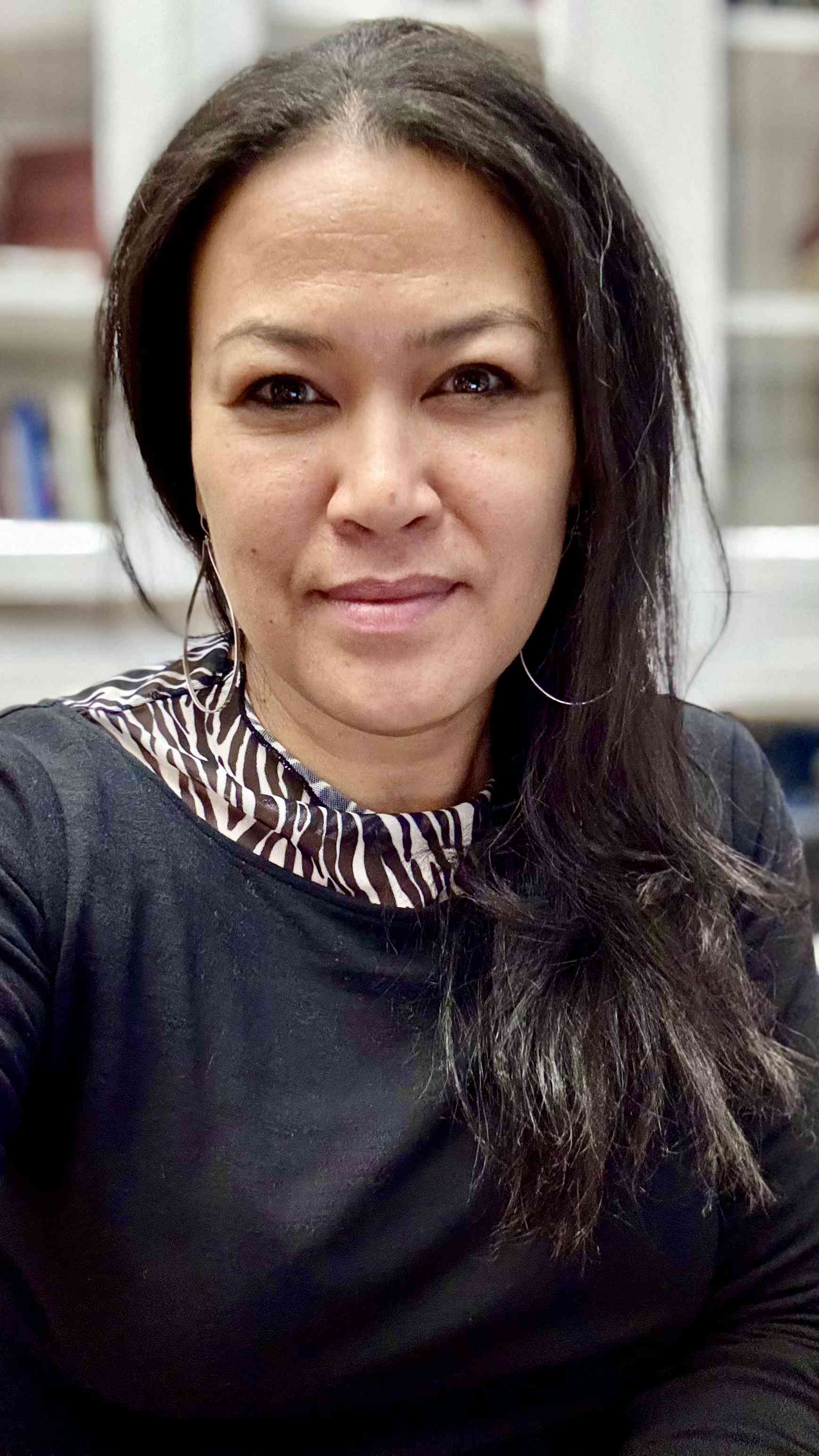
Jacqueline Simmons is an Assistant Professor of Teaching at Teachers College, Columbia University and Program Director for the masters programs in curriculum studies. Her research examines the design, theory, and critical analysis of curricula with particular attention to youth, media, sense-making, and conceptions of innovation. Learn more at: www.jaxsie.com
Sarah Gerth is a Visiting Researcher at the Digital Futures Institute, whose research involves the role of senses, affects, and materiality in ways of knowing. She is the Dean of the City Learning Ecology at City Seminary of New York, where she designs curriculum at the intersection of creative practice, place, and theology, and co-founder of Shapes of Knowledge, a curriculum design studio for creative engagements with learning. Learn more at: www.shapesofknowledge.studio
Jackie and Sarah collaboratively run the Black Paint Curriculum Lab,
a creative space for faculty, students, and alumni to reimagine
possibilities for curriculum making as a public endeavor.
Learn more about the Black Paint Curriculum Lab at www.tc.columbia.edu/black-paint-curriculum-lab
Subscribe
Subscribe on Spotify, Apple Podcasts, or wherever you listen.




Global Listeners Badge: Reaching Listeners in 25+ Countries!